
Now that you know how to form a sentence in Dutch, you want to learn all the building blocks you need for that. Seeing how most of our sentences start with “I” – “ikke”* – it makes sense to start from there.

Yes, I am talking to you, Travis, and everyone else who reads this enlightening piece of information that I am writing down right now. Because the whole purpose of this post is to get you acquainted with the so called Personal Pronouns. Why? Because you can’t live without them.
Dutch is a context based language, which means that we will depend on referring to things a lot or we will be lost. In Slavic languages for instance, you would use a grammatical case, which means that the ending of a noun will indicate how that word is used; if I give something to someone or just call out her/his name, that will be reflected in the ending of the word. We can’t do that in Dutch, so we make use of prepositions a lot and we tend to repeat ourselves with referring to things. More about that in a next post, for now, let’s keep it simple and look at the personal pronouns you need to start making sentences right away!
There are three types of personal pronouns:
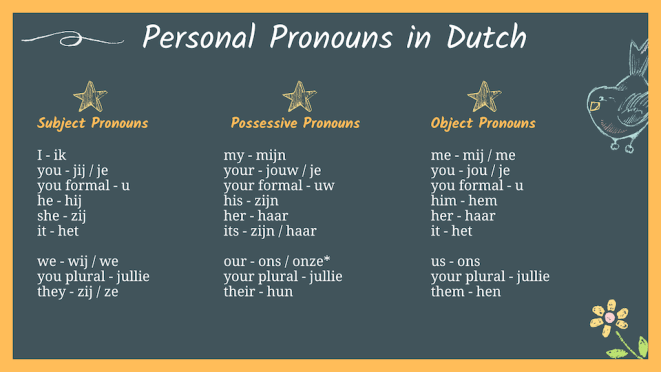
Well, Dutch is not a hard language, but it can be confusing. Look at the difference between “jij” and “je”. They mean the same thing, but “jij” has more emphasis to it, and “je” is rather neutral. Same goes for the difference between “zij” and “ze”, “wij” and “we”, “jouw” and “je”, “jou” and “je” and “mij” and “me”. All the firstly mentioned forms of the pronouns are pronounced with emphasis.
That doesn’t count for “ons” and “onze”. The difference here has nothing to do with emphasis but rather the word it is referring to.
In Dutch, we have three types of articles:
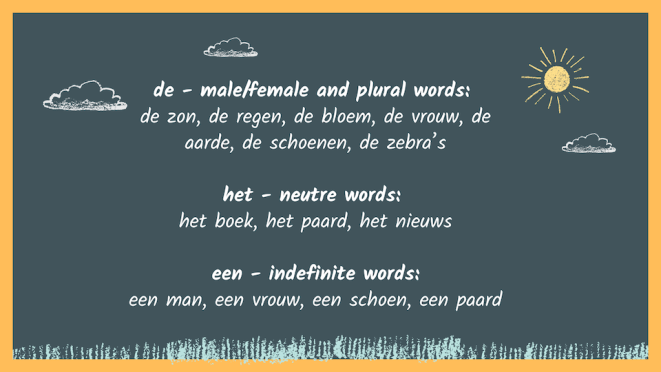
De-words and het-words in English only know one article and that is “the”. Een is translated as “a” or “an” in English. Don’t ask questions like: what is a masculine or feminine word, because even Dutch people don’t know. It took them their whole elementary school to learn which article goes with which noun by using the learning method “monkey hear, monkey do”. In your case, it will probably take the rest of your life, but repetition truly is the key here. At one point, you will “feel” that de raam is just wrong and that it should be het raam*. If you really want to know if a word is de or het, look it up in the dictionary.
Now, let’s get back to “ons” and “onze” and the whole point why we had to take this detour. Unfortunately, when it comes to saying something is “ours” in Dutch, you will have to know if the thing you are talking about has the article de or het.
ONS – USED FOR HET-WORDS // ONZE – USED FOR DE-WORDS
Ons huis (het huis), ons feest (het feest), onze les (de les), onze bloemen (de bloemen).
Do you want to sound even more Dutch? You could take it one step further and use one of these (because, waarom niet!*):

We added a few words here that will make you sound like you were born and raised a true kaaskop*.
m’n – pronounced as mun
z’n – pronounced as zun
d’r – pronounced as dur
‘m – pronounced as um
None of these are emphasised and used in written language. So, be careful with that!
Hope you have a better understanding of Dutch personal pronouns now. See you next time for some more grammar!
*ikke = me – used mostly in a childlike way, like: who wants chocolate? – ikke, ikke, ikke! And often also used negatively: ikke, ikke, ikke, en de rest kan stikken = me, me, me, and the rest can choke to death. Let’s not forget the dark side of this language…
*het raam = the window
*waarom niet = why not
*kaaskop = cheesehead – a very very negative word used to refer to Dutch people, we prefer not to use it anymore, but again, can’t escape the negative side you know…
 Key to Dutch - Dutch language courses in Leiden